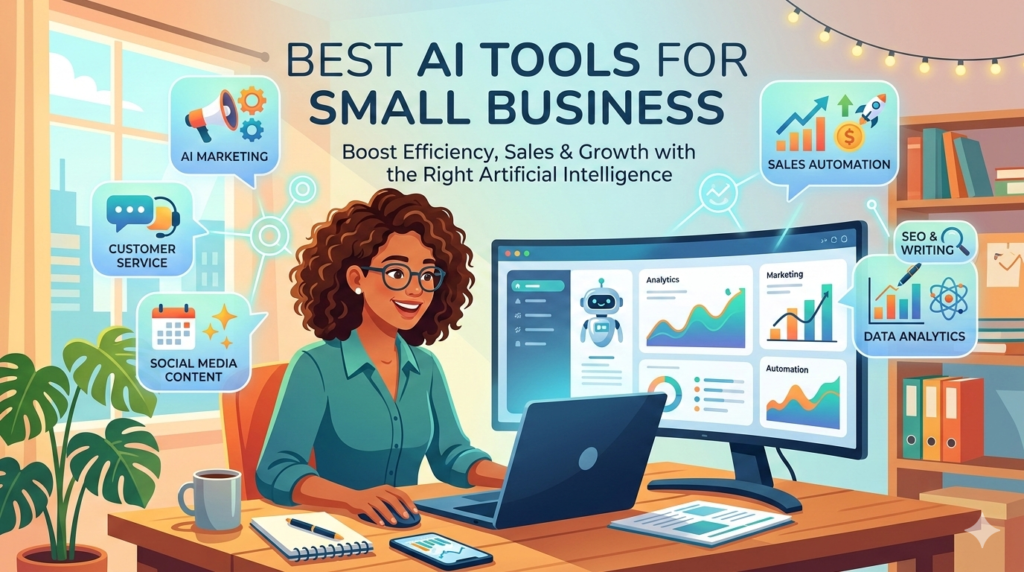
Artificial intelligence is no longer optional for small businesses. In 2026, AI tools for small businesses help companies automate routine work, reduce costs, and make faster decisions. Small teams can now handle marketing, customer service, sales, and operations with tools that once required large departments. AI improves efficiency, accuracy, and scalability without increasing staff. Businesses that adopt AI early gain a competitive advantage through better customer experiences and smarter workflows. Whether the goal is growth, automation, or profitability, AI enables small businesses to operate like larger companies while staying agile and cost efficient.
Key Trends Shaping AI Adoption for Small Businesses in 2026
Small business AI adoption is driven by several major trends:
Top AI trends in 2026
- No-code and low-code AI tools
- AI agents that automate full workflows
- Hyper-personalization in marketing and support
- Integration across multiple business platforms
- Industry-specific AI solutions
- Improved data privacy and compliance features
These trends make AI more accessible and practical. Instead of complex systems, businesses can implement ready-to-use tools that deliver quick results and a measurable return on investment.
How to Choose the Right AI Tools for Your Small Business
Checklist for selecting AI tools
- Define your business goal first
- Calculate expected ROI
- Choose simple and user-friendly tools
- Ensure integration with existing systems
- Verify data security and compliance
- Start with one tool and scale gradually
Quick Evaluation Table
| Factor | What to Check | Why It Matters |
|---|---|---|
| Business Goal | Sales, marketing, support, or operations | Avoid unnecessary tools |
| Pricing | Subscription, usage limits | Control long term costs |
| Ease of Use | Templates, automation, onboarding | Faster adoption |
| Integration | CRM, email, ecommerce, accounting | Workflow efficiency |
| Security | Encryption, privacy policy | Protect customer data |
Benefits
- Faster content production
- Consistent brand voice
- Improve
Top Writing AI Tools for Small Businesses in 2026
Best tools by purpose
- Long form content: ChatGPT, Jasper, Writesonic
- SEO optimization: Surfer SEO, Frase, NeuronWriter
- Email marketing: Mailchimp AI, HubSpot AI
- Product descriptions: Copy.ai, Anyword
- Landing pages: Unbounce AI, Durable
Comparison Table
| Tool | Best For | Ideal Business Type |
|---|---|---|
| ChatGPT | All purpose content | Any small business |
| Jasper | Marketing copy | Agencies, ecommerce |
| Surfer SEO | SEO content optimization | Bloggers, niche sites |
| Copy.ai | Sales and product copy | Ecommerce |
AI Tools for Customer Support and Engagement
Top customer support AI tools for small Business
| Tool | Feature | Use Case |
|---|---|---|
| Tidio | AI chatbot | Website customer support |
| Intercom | Automated messaging | SaaS and service businesses |
| Zendesk AI | Ticket automation | Customer service teams |
| Freshdesk AI | Smart responses | Multi channel support |
Key advantages
- 24/7 customer service
- Reduced response time
- Lower support costs
- Personalized interactions
Best AI Tools for Sales and Lead Generation
Popular sales AI tools for small Business
| Category | Tools | Function |
|---|---|---|
| CRM | HubSpot AI, Zoho CRM AI | Contact and pipeline management |
| Lead Scoring | Salesforce Einstein, Pipedrive AI | Identify high value leads |
| Outreach | Lavender, Reply.io | Email optimization and follow ups |
| Forecasting | Clari, InsightSquared | Sales prediction and planning |
Why it matters
- Focus on high-intent prospects
- Automate follow-ups.
- Increase conversion rates
AI Tools for Accounting and Financial Management
| Tool | Best For | Key Feature |
|---|---|---|
| QuickBooks AI | Small business accounting | Automated bookkeeping |
| Xero | Expense tracking | Bank reconciliation |
| FreshBooks | Invoicing | Payment automation |
| Vic.ai | Finance automation | AI driven insights |
Benefits
- Real-time financial visibility
- Reduced manual errors
- Automated tax preparation
- Cash flow forecasting
AI Tools for Operations and Workflow Automation
Top automation tools
- Zapier AI
- Make.com
- Notion AI
- ClickUp AI
- Airtable AI
Workflow Use Cases
| Process | AI Automation Example |
|---|---|
| Lead capture | Form to CRM automation |
| Reporting | Auto generated dashboards |
| Task management | AI project planning |
| Documentation | Auto generated contracts |
AI Tools for HR and Team Management
| Function | Tools | Use Case |
|---|---|---|
| Hiring | HireVue, Pymetrics | Resume screening |
| Onboarding | BambooHR AI | Employee setup |
| Performance | Lattice AI | Workforce analytics |
| Knowledge | Notion AI | Internal documentation |
Impact
- Faster hiring
- Better employee experience
- Data-driven performance management
Best AI Design and Creative Tools for Branding
Top creative AI tools for small Business
- Canva AI for social media and branding
- Looka for logo design
- Adobe Firefly for image generation
- Runway for video creation
- Remove.bg for background editing
These tools help small businesses create professional marketing assets without hiring designers.
AI Tools for Ecommerce and Retail Businesses
| Category | Tools | Benefit |
|---|---|---|
| Recommendations | Shopify Magic, Nosto | Personalized shopping |
| Inventory | Netstock, StockIQ | Demand forecasting |
| Pricing | Prisync, Dynamic Yield | Dynamic pricing |
| Personalization | Klaviyo AI | Customer retention |
Results
- Higher average order value
- Reduced stockouts
- Better customer experience
Free vs Paid AI Tools: What Small Businesses Should Know
When free ai tools for small business are enough
- Basic content creation
- Testing new workflows
- Small scale operations
Limitations of free plans
- Usage limits
- Fewer features
- Limited integrations
- Branding or watermarks
How to evaluate paid tools
- Time saved per month
- Revenue impact
- Scalability
- Integration capability
Common Mistakes Small Businesses Make When Using AI
- Using multiple tools without strategy
- Expecting AI to work without human review
- Ignoring data quality
- Over automating customer interactions
- Not training team members
Avoiding these mistakes ensures better results and long term AI success.
AI Implementation Roadmap for Small Businesses
Step by step plan
- Identify biggest time consuming task
- Choose one AI tool to solve it
- Test with a small workflow
- Measure time or cost savings
- Train team and standardize process
- Expand to other areas gradually
Quick Win Areas
- Content creation
- Customer chatbots
- Email automation
- Social media scheduling
Future of AI for Small Businesses Beyond 2026
Emerging trends
- Autonomous business operations
- AI agents managing workflows
- Predictive decision making
- Real time personalization
- Connected AI ecosystems
Businesses that adopt AI early will operate faster, smarter, and more efficiently than competitors.
Building a Smarter, More Efficient Small Business with AI
AI enables small businesses to scale without increasing costs or team size. The key is to start with clear goals, choose simple tools, and focus on measurable results. Begin with one high-impact area such as content, customer support, or automation. As efficiency improves, expand AI into other functions. Early adoption provides a strong competitive advantage through better productivity, faster decision-making, and improved customer experience. In 2026 and beyond, businesses that use AI strategically will grow faster and operate more efficiently than those that rely only on manual processes.
Pingback: Best AI Tools for Digital Marketing Agencies in 2026 - AI Tool Farmer